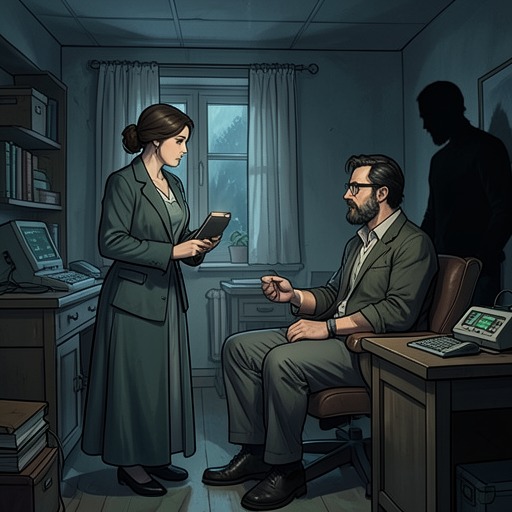
Ester’s hotel-room encounter witnessed by Bernard
The Lighthouse (Alison Moore Edition)Ester’s hotel-room encounter, and Bernard’s sighting of her leaving room six, make the Hellhaus Hotel’s private rooms a stage where sexual intimacy, paid hospitality, and suspicion become difficult to separate. The episode first shows Ester choosing an unnamed guest and entering a room with him; elsewhere in the hotel’s events, Bernard sees her leave a guest room and then notices Futh, partly undressed, at its door. The juxtaposition is consequential less because it confirms what Bernard believes than because it gives an ambiguous glimpse the force of an accusation.
Setting and Circumstances
Ester’s encounter begins during a lull in her work. Just after eleven, after finishing the downstairs rooms, she sits at the bar, removes her rubber gloves, and drinks gin with a little tonic. A middle-aged customer has come in for breakfast. He watches her over his coffee while peeling a hard-boiled egg; she initially avoids his gaze, then notices his butterfly tattoo. The hotel’s routines continue around them, but the bar is quiet enough for a look, a pause, and a movement toward the guest rooms to become the scene’s decisive signals.
Ester tells the man she must return to work and says she is taking a break. He says he is passing through. She gets down from her stool and walks toward the internal door leading to the rooms, glancing back at him before she goes through. He follows, leaving the broken eggshell on the bar. The encounter is not presented as a guest’s ordinary request for service: Ester initiates the private transition, while the man’s pursuit completes it. Yet the hotel is also her workplace, and the room is one she will have to clean.
The Room and the Encounter
The man lies on a bed vacated that morning by an American couple. Ester can still see their dark hairs on the pillowcases. He looks directly and insistently at her breasts, while she looks near him or past him rather than meeting his gaze. His scrutiny recalls her adolescence, when she collected pictures of breasts in a scrapbook: images from catalogues, travel brochures, and magazines. Now nearing forty, she has almost forgotten that private collection, but the customer’s attention returns her to the girl who studied those images and coveted what she did not have.
The recollection makes the encounter more than a simple exchange of looks. Ester’s body is being watched, but the scene also gives her an interior history that is not supplied by the man’s gaze. She gets onto the bed; he continues looking at her breasts, and she scarcely looks at him. Afterward, he closes his eyes and falls asleep. The account is brief and unsentimental: the encounter occupies time that Ester needs for work, rather than displacing that work from her mind.
She still has two rooms to finish before lunch, with toilets, sinks, baths, floors, carpets, and beds to clean. Her established practice is to use rooms she has not yet serviced, or rooms whose occupants are out, then straighten the bedding. She has changed this practice after complaints about the sheets. The man’s bed will therefore become part of the workday’s immediate return: the guest room is at once a place of sex and a surface to be made ready for hotel use.
Afterward and the Witness
When the man sleeps, his fingertips rest lightly on Ester’s arm. She moves away, and they slip from her skin. She dresses, picking hairs from her clothes, then searches his jeans and takes a cigarette from his packet. With his red Bic lighter, she lights it at an open window and exhales smoke over the people below. The small actions—withdrawal from his touch, dressing, taking the cigarette—carry the encounter out of the room without turning it into a declaration of attachment.
A later sighting at the hotel gives the private room a different charge. A door marked PRIVATE separates the guest rooms from the rooms occupied by Ester and her husband, Bernard. Coming through that door, Bernard sees Ester hurriedly leaving room six. Moments later, a man appears in the doorway. Bernard sees only parts of him—a bare shoulder, a ridged spine, a white leg, and a blue-veined foot on the carpet—before the man notices Bernard, withdraws, and locks the door. The account does not establish that this man is the customer with the egg and butterfly tattoo; nor does it make the meaning of Bernard’s glimpse certain. What it does establish is the abrupt sequence Bernard witnesses and the appearance of a secret being concealed.
Consequences and Significance
The next morning, Futh sees a new bruise on Ester’s face beneath her make-up. Bernard, whom Futh recognizes as the man from the corridor, refuses to answer his breakfast question and tells him to go. The sequence connects the hotel’s intimate spaces with threat and exclusion, though the bruise alone does not specify how it was caused. In a place where rooms are entered for cleaning, meals are delivered, and doors divide family quarters from guest accommodation, a boundary can be crossed or misread in an instant.
Futh’s later search for the missing silver lighthouse extends that unease into the hotel’s private rooms. He steps through the door marked PRIVATE, hides in Ester’s bathroom, and watches her put the lighthouse away in a drawer. When he smells camphor from a bottle by the bath, the scent takes him back to his mother’s wardrobe, which he had imagined bottling as an essence of her. The encounter and its aftermath thus sit within a larger pattern of rooms, objects, and sensory memories carrying meanings their occupants cannot openly settle. Bernard’s sighting is powerful precisely because it supplies an image—Ester leaving, a man exposed at the door—without giving the reader certainty about everything that image implies.